Tuesday, April 25, 2017

Frank Miller got me thinking...
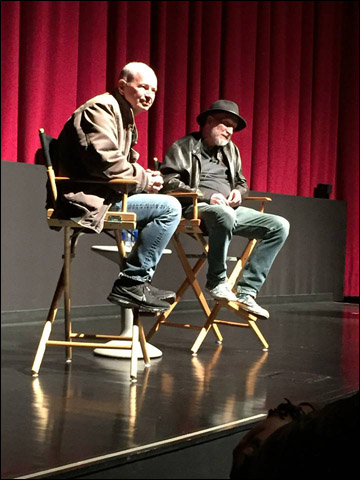


Above photo (Left to right): Klaus Janson and Frank Miller at the School of Visual Arts’ “100 Years of Genius: The Life and Legacy of Will Eisner” event in April 2017. Photo by (DC Comics editor and SVA faculty member) Joey Cavalieri.

Frank Miller got me thinking.

On April 4, 2017, during his chat at the School of Visual Arts’ “100 Years of Genius: The Life and Legacy of Will Eisner,” Frank Miller talked a bit on the topic of Will Eisner and comic book Creators’ Rights. Miller explained Will’s views on comic book Creator’s Rights and contracts:

The most frequent business advice [Will Eisner] gave me was: ‘Stop whining.’ Because I would go in saying: ‘Creators’ Rights this, Creators’ Rights that, Creators’ Rights this.’ And he’d say: ‘Look, if you sign the contract, it’s over. Stop complaining about anything.’ His point of view was simply that if you’re working on other people’s material, then you don’t have that much of a claim. And so, clearly, his whole point was that the future of comics was for people to be introducing new material.

(You can watch the entirety of SVA’s “100 Years of Genius: The Life and Legacy of Will Eisner” event here on Youtube.)

In the book EISNER/MILLER, Will stated:

Take a look at the marketplace and understand what its realties are. I never subscribed to this Creators’ Bill of Rights because I believe that there was no reality to it. In the marketplace, moral rights are often disregarded.

And…

Well, there is no ingrained right, there are no God-given rights here. The rights are what you negotiate.

Now, it’s true that Will was a very savvy business person. (And you really have to be if you want to have a successful career in the arts.) I don’t think that Will would have needed to be reminded by something like (the very important) Creators’ Bill of Rights. However, the vast majority of young artists do need to be reminded and told about the Bill and about Creators’ Rights.

(I lecture on all of this in my Sequential Art: Comics Illustration class at SUNY Orange.)

In an interview on the Creators’ Bill of Rights and Creators’ Rights for THE COMICS JOURNAL (No. 137, September 1990) by Gary Groth and with Steve Bissette, Scott McCloud stated:

Whatever crimes are going on at companies where Creators’ Rights are not honored become pretty quickly irrelevant because essentially it’s your own damn fault if you decide to work there… if there is an alternative… yeah, if you went in with some knowledge. ‘What’s smoking?’ As long as the warning is there.

(A must-read and/or must-listen interview with Stephen Bissette and Scott McCloud.)

Over the years, I’ve been quite outspoken about comic book Creator’s Rights.

In 2005, I began becoming more vocal and more public about my views on Creators’ Rights. I started conversations with folks like Steve Bissette, Dave Sim, Rick Veitch, Scott McCloud, and even with Denis Kitchen, Erik Larsen, and Fernando Ruiz.

(All of these discussions are collected and posted at www.yacanteraseink.com)

Dave Sim had suggested to me that my eventual departure from Archie Comics may have been due to my public outspokenness on Creators’ Rights. Dave could very well be right.

In 2010, I officially ended my contributions toward work-made-for-hire.

(Two weeks ago, for about an hour, I was on the phone with a publisher and trying to convince him that I had no interest in working on their work-made-for-hire project.)
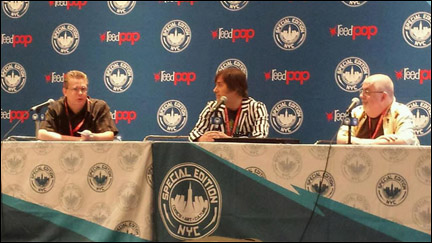


Above photo: This photo was taken in June 2014 during the "Creator-owned Comics (vs. Corporate-owned Comics)" panel at the Special Edition: NYC comics convention which was held at the Jacob Javits Center in New York City. I was joined on the panel by Mike Allred and Kurt Busiek.

In 2014, I was on the “Creator-owned Comics (vs. Corporate-owned Comics)” panel held at the Special Edition: NYC comics convention. The panel featured a discussion between myself, Michael Allred, and Kurt Busiek. That panel pretty much summed up my view on Creators’ Rights in regards to Creator-owned Comics versus Corporate-owned Comics.

Simply put: Comic book publishers have a horrible history with treating their writers and artists. If you’re interested in playing in the work-made-for-hire sandbox, then know the environment in which you’re working and know what your rights are. For me, now, creator-owned comics are the only thing that I’ll be doing in comics.

The topic of comic book Creators’ Rights does still interest me a great deal. I still believe that, at the very least, the Creator’s Bill of Rights is a must-read for professional comic book creators and for young artists who wish to have a career in comics and/or in animation.

It’s just that, now, I don’t know if we can actually change the policies of comic book publishers that promote work-made-for-hire. Maybe it’s just best to ignore the likes of Marvel and DC. There are more creator-friendly publishers out there. Why keep flogging a dead horse?

My opinion hasn’t changed, exactly. I like to think that my focus has just evolved. I don’t care what the corporate comic publishers are doing anymore.

I’m wondering if Will Eisner was more often correct about Creators' Rights than I previously thought.

Labels: , , , , , , ,

Tuesday, August 23, 2011

DESTROY and DESTROY again…


Above: Cover to Scott McCloud’s DESTROY!! which was published in 1986.

From Scott McCloud:

I got the idea when I first heard people complaining about a Marvel comic called SuperBoxers and claiming that it was "nothing but senseless violence from beginning to end." I thought this sounded cool, but was disappointed, upon acquiring a copy, to discover that SuperBoxers included a plot, characterization, and other distractions. It wasn't PURE. Destroy!! was my attempt to get it right.


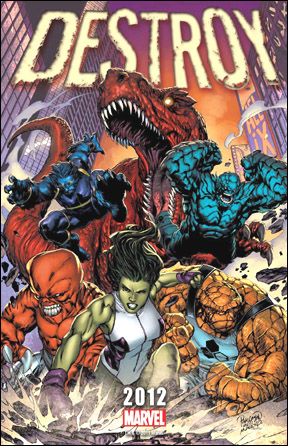
Above: Cover to Marvel Comics’ forthcoming DESTROY by Carlo Pagulayan.

Scott’s DESTROY was a very funny parody. And Marvel’s more serious use of the title name makes me wonder if the publisher can’t come up with some new ideas.

Labels: , ,

Wednesday, March 3, 2010

Scott McCloud...


Above photo: Scott McCloud, cartoonist and author of UNDERSTANDING COMICS and MAKING COMICS.

Here's an interesting article about/with Scott McCloud:

"One of the problems with Reinventing is that it includes a lot of ideas I’d had from years before and never got around to putting in a book," Scott admits. "I’m still passionately devoted to them, but was still moving on from some of them; especially some of the stuff from the first half of the book that were things from years before. There was stuff like the Creators’ Bill or Rights, which I’d been thinking about, and decided that it was something I needed to put to paper. It was like cleaning up. I think it felt that way for a lot of people, a little by the numbers."

And…

"I’ve always been more interested in what’s possible in the future than what’s happened in the past. I’ve never been very nostalgic and have never been much of a collector. You’re never going to hear me moaning about how much better comics were when I was a kid, because they weren’t! Comics are much better now…"

Labels: , ,

Wednesday, February 3, 2010

"Comics and Work-Made-for-Hire: Creator’s Rights"


According to the Library of Congress, work-made-for-hire is, in part, described thusly: "Although the general rule is that the person who creates a work is the author of that work, there is an exception to that principle: the copyright law defines a category of works called ‘works made for hire.’ If a work is ‘made for hire,’ the employer, and not the employee, is considered the author. The employer may be a firm, an organization, or an individual."

If done respectfully, I don’t have a real problem with work-made-for-hire in the comic book industry. I don’t have a problem with someone being compensated for employing his or her skills at the request of a publisher. I do have a problem when work-for-hire is used to promote unethical treatment.

I don’t have to tell you about how comic book creators have been abused. I don’t have to tell you about how certain editors or publishers stole or swindled ideas or creations from artists and writers. I don’t have to tell you about the fight for the return of artwork to those who created that artwork. I don’t have to tell you about the right for creators to receive royalties.

However, if you think that these are issues of the past, then I do have to tell you that you’re dead wrong. There are some publishers today that do not return artwork back to all of its creators. There are some that do not offer royalties. There are some that don’t even guarantee creator credits.

Although things have gotten better for comic book creators and freelancers, not all comic book publishers abide by certain ethical practices. We work in an industry that has been appropriately coined by Steve Bissette (for THE COMICS JOURNAL) as "a moral ghetto."

In the world of commercial art, the Graphic Artists Guild has "the Code of Fair Practice." This is a list of ethics promoted by the Graphic Artists Guild.

In comics, we have the Creator’s Bill of Rights. Back in 1988, a group of comic book creators got together to see what they could do about protecting the rights of comic book creators. From these series of summits, specifically at Northampton, Massachusetts, the Creator’s Bill of Rights was produced. The participants of the Bill’s creation included Scott McCloud, Dave Sim, Gerhard, Steve Bissette, Rick Veitch, Larry Marder, Kevin Eastman, Peter Laird, Mark Martin, Steve Murphy, Michael Zulli, Eric Talbot, Ken Mitchroney, Michael Dooney, Steve Lavigne, Craig Farley, Jim Lawson and Ryan Brown. (I’m sorry if I left anyone out.)

The Creator’s Bill of Rights states various rights including "the right to full ownership of what we fully create," "the right to prompt and complete return of our artwork in its original condition," and "the right of approval over the methods by which our creative property is distributed." Some of these rights seem pretty basic, but they are not all honored today.

Sadly, the Creator’s Bill of Rights is largely ignored by many creators and publishers. It’s easy to ignore poor conduct when there is a lack of, or ignorance of, an established list of ethics. It’s even obvious why a comic book publisher would want to ignore the Creator’s Bill of Rights. But, why would a comics creator do so?

My intent here is to make cartoonists, especially young ones, aware of some of the pitfalls in the comics industry. At the very least, the Creator’s Bill of Rights should be looked upon as such. I’m hoping for outspoken discussion and awareness on creator’s rights issues while instilling change in our industry.

Tomorrow, I’ll start posting responses from various comic book creators from the likes of Erik Larsen, Fernando Ruiz, and Steve Bissette.

For more info regarding comic book Creator’s Rights stop by Ya Can’t Erase Ink and the Creator’s Rights forum.

Labels: , , ,